Code: GIFT Save 10%

Electromagnetic Hypersensitivity: The Real Stories of People Living With EHS
Imagine becoming uncomfortable in places that once felt completely ordinary. Your home, workplace, grocery store, church, hotel, or even a visit with family can become difficult because wireless technology is now almost everywhere.
For people living with electromagnetic hypersensitivity, commonly called EHS, this can become an overwhelming part of everyday life. People describe headaches, burning or tingling sensations, sleep problems, dizziness, fatigue, difficulty concentrating, ringing in the ears, heart palpitations, nausea, and many other symptoms. The World Health Organization acknowledges that the symptoms reported by people with EHS are real, can vary widely in severity, and can become disabling for the affected individual.
Some people describe becoming so sensitive that they have changed careers, left their homes, moved to rural areas, altered relationships, or searched for places where wireless exposure is much lower.
Behind the term EHS are people whose lives have been dramatically changed.
Their stories deserve to be heard.
What Is Electromagnetic Hypersensitivity?
Electromagnetic hypersensitivity describes a range of symptoms people experience in environments containing electromagnetic fields. People with EHS commonly identify sources such as cell phones, WiFi routers, cell towers, smart meters, Bluetooth devices, wireless equipment, and electrical systems.
The experience is not identical for everyone. One person may struggle primarily with headaches and sleep. Another may experience burning sensations, dizziness, fatigue, heart palpitations, nausea, or difficulty concentrating. The WHO lists many of these same symptoms in its information about EHS and recognizes that the severity can differ greatly from one person to another.
Some people are able to manage their environment with relatively modest changes. Others describe EHS as debilitating. To understand just how profoundly this can affect someone’s life, it helps to hear directly from people who have lived through it.
Sue Left Her Life in New York
Sue Howard’s story provides a powerful example of the sacrifices some people have made.
Sue lived in Westchester County, New York, and described experiencing constant headaches along with burning, tingling, numbness, problems with her eyes, and other symptoms. She sought help while trying to understand what was happening. Eventually, Sue and her husband began changing their environment, including hardwiring their internet.
Her search eventually led her to Green Bank, West Virginia, an area known for restrictions on radio transmissions because of the sensitive equipment used at the Green Bank Observatory.
Her story was featured by PBS, which documented the sacrifices she and her husband made while establishing a life in an environment with fewer radio transmissions.
Watch Sue Howard’s story from PBS
Sue’s story is especially moving because relocation does not simply mean changing houses. It can mean leaving behind friends, family, familiar surroundings, medical providers, churches, businesses, and an entire community.
Brandon Left Behind His Business and Family
Brandon Barrett’s experience was documented in an extensive Washington Post report about people with electromagnetic sensitivity who moved to Green Bank.
Brandon had been physically active and operated a motorcycle shop near Buffalo. He described developing brain fog, memory and concentration difficulties, fatigue, anxiety, and other problems. He eventually began spending time in more rural environments and later traveled to Green Bank in search of a place where he could live more comfortably.
His story shows what debilitating EHS can look like for some people. It can extend far beyond simply turning off a WiFi router before going to bed. A person’s work, housing, relationships, and independence can all be affected.
The same report tells the stories of several other people who moved to this unusual community.
Read the Green Bank EHS stories in The Washington Post
Audra Built a Life Away From the City
The Washington Post also documented the experience of Audra Bogacik, a former dental hygienist from Pittsburgh.
Audra described physical symptoms that she associated with her electromagnetic environment and eventually moved to the Green Bank area. Her father helped her establish an isolated camp in the mountains.
Her story illustrates something that receives far too little attention when discussing EHS: isolation.
People can lose much more than access to technology. Friendships, careers, social gatherings, restaurants, entertainment, travel, and ordinary family activities can become difficult. When wireless technology is almost everywhere, reducing exposure can also mean reducing contact with other people.
That human cost is important to understand.
Other Stories From People Living With EHS
Green Bank is not the only place where these experiences have been documented. People from many different occupations and backgrounds have publicly described major changes to their lives after developing electromagnetic sensitivity.
Some have changed the way they work. Others have modified their homes, reduced wireless technology, moved to rural areas, or searched for places where they feel more comfortable.
These personal accounts are valuable because they allow people with EHS to tell their own stories rather than having someone else describe the experience for them.
Explore EHS stories and resources from Environmental Health Trust
The Canary in the Coal Mine
A phrase frequently heard within the EHS community is “the canary in the coal mine.”
Coal miners once carried canaries underground because the birds could provide an early warning when dangerous gases were present. Some people with EHS use this analogy to describe themselves because they feel changes in electromagnetic environments that other people around them may not notice.
It is a thought provoking comparison in today’s increasingly connected world.
WiFi, cell phones, Bluetooth, wireless security systems, smart meters, wireless appliances, connected vehicles, tablets, watches, and other wireless technologies have become embedded in everyday life. For someone trying to reduce wireless exposure, finding a quiet environment can therefore become extremely difficult.
Green Bank Became a Refuge
Green Bank has become particularly well known in EHS stories because it sits within the National Radio Quiet Zone surrounding the Green Bank Observatory. Radio transmissions are restricted in the area because the observatory’s sensitive equipment needs protection from radio interference.
Over time, some people with EHS began moving there.
Their stories are important because moving to an isolated area is not a minor lifestyle adjustment. People have left established homes and communities while searching for environments they find more tolerable.
For someone who has never experienced EHS, it may be difficult to imagine making such a decision. For someone struggling every day, the search for a place to live comfortably can become more important than almost everything else.
What Can We Do to Help Someone Living With EHS?
Perhaps the first thing we can do is listen.
If someone tells you that being around a phone, WiFi router, or another wireless device makes it difficult for them to remain in a room, a little consideration can go a long way.
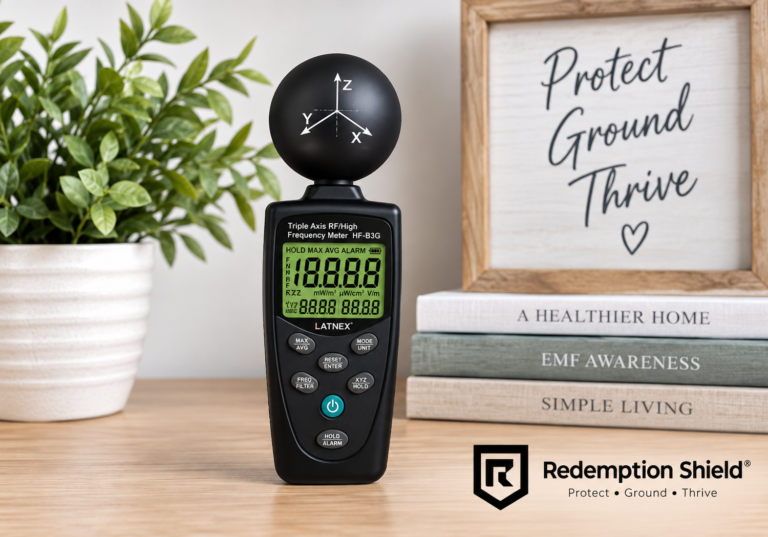
For someone dealing with EHS in their own home, I recommend starting by understanding the environment. An appropriate meter can help identify where RF levels are strongest. Check bedrooms, windows, walls, routers, smart meters, and the places where the person spends the greatest amount of time.
Then look at what can be controlled. Move wireless equipment farther away when possible. Hardwire computers where practical. Turn off wireless devices that are not needed, especially during sleep. Keep phones away from the bed and investigate outside sources such as nearby cell towers, neighboring WiFi, or smart meters.
For readers who are just beginning to understand this subject, our Ultimate Guide to EMF Protection explains several practical approaches to reducing exposure and creating a more protected environment.
Read the Redemption Shield Ultimate Guide to EMF Protection
Shielding Can Be Part of the Solution
When an outside RF source cannot simply be turned off, shielding can be considered as part of the environment.
For RF entering through windows, Redemption Shield EMF shielding curtains are made from silver spun shielding fabric and are designed to reduce RF entering through the covered window area.
Explore Redemption Shield EMF Shielding Curtains
For larger projects, Faraday shielding fabric can be used for certain walls, enclosures, and custom shielding applications. Redemption Shield’s military grade Faraday fabric has laboratory tested shielding effectiveness across its tested frequency range.
Explore Redemption Shield Faraday Shielding Fabric
For the sleeping area, an EMF shielding bed canopy can provide shielding around the bed. Redemption Shield offers several silver spun cotton and nylon canopy options.
Explore Redemption Shield EMF Shielding Bed Canopies
Coverage and placement matter. A piece of shielding material placed randomly in a room is not the same as understanding where RF is entering and creating a shielding plan around the actual environment.
This is why I continue to recommend a simple approach:
Measure. Identify. Reduce what you can. Shield where appropriate. Measure again.
Grounding is another tool, but grounding and RF shielding serve different purposes and should not automatically be treated as the same solution.
Helping Someone May Be Simpler Than You Think
You do not necessarily need to renovate someone’s home to help. Sometimes small and thoughtful accommodations can make it much easier for a person with EHS to participate in everyday life. If someone with EHS visits your home, ask what would make the environment more comfortable for them. It may be as simple as turning off the WiFi for a while, placing phones into Airplane Mode during dinner, or choosing to spend time outside rather than inside a building filled with wireless devices.
Churches can consider seating farther away from wireless equipment for people who are sensitive, while employers may be able to provide a wired workstation, move a desk away from wireless access points, or allow someone to work remotely from an environment they have already adapted. These may seem like small changes, but they can help someone remain connected to family, friends, employment, church, and community instead of becoming increasingly isolated.
You Are Not Alone
Isolation can be one of the hardest parts of living with EHS.
Imagine struggling to enter buildings that everyone else enters without thinking. Imagine declining invitations because of the wireless environment. Imagine searching for housing based not only on price and location, but also on cell towers, smart meters, neighboring WiFi, and other environmental conditions.
Then imagine trying to explain all of this to someone who has never experienced it.
Stories like those from Green Bank matter because they show people struggling with EHS that there are others who understand what they are going through.
Learn more about electromagnetic hypersensitivity from the World Health Organization
Gina’s Thoughts
This subject is very close to my heart because my own journey with electromagnetic sensitivity began in 2018.
My experience changed the way I looked at the environment around me. I began asking questions I had never thought about before. What was around me? What could I control? How could I create an environment where I felt more comfortable?
Finding trustworthy information and effective solutions was difficult. That search eventually became part of the journey that led me to build Redemption Shield.
Since then, I have spoken with people whose lives have been affected in ways that many others never see. Some are simply trying to sleep comfortably in their own bedrooms. Some are dealing with a nearby tower or smart meter. Others are trying to figure out how they can continue working, traveling, attending church, or simply spending time with the people they love.
When I read stories about people leaving their homes, careers, and communities, I understand why awareness matters.
We may not personally understand everything another person is experiencing, but we can still show compassion. We can listen. We can turn off a device. We can put a phone into Airplane Mode. We can help someone understand their environment. Most importantly, we can make sure they know they are still welcome in our lives.
One Scripture that comes to mind is Galatians 6:2: “Bear ye one another’s burdens, and so fulfil the law of Christ.”
Sometimes bearing someone’s burden begins with something as simple as listening, making an accommodation, and showing them that they are not alone.
Gina Paeth, Founder of Redemption Shield
Redemption Shield Is Here to Help
Redemption Shield began in part from my own search for practical EMF solutions, and helping people who are struggling with their environments remains important to us.
If you are dealing with EHS and are unsure where to begin, you can reach out to Redemption Shield. Tell us what is happening in your environment, what area you are trying to protect, and what sources you are concerned about. We can help you think through practical options, including shielding curtains, Faraday fabric, bed canopies, grounding products, and other approaches.
We do not believe every home needs the same solution. Understanding your environment comes first.
Contact Redemption Shield for help with your environment
Redemption Shield®
EMF Protection at Its Finest™
PROTECT • GROUND • THRIVE
#ElectromagneticHypersensitivity #EHS #ElectromagneticSensitivity #EHSSymptoms #EMFSensitivity #LivingWithEHS #EHSStories #EMFExposure #RFExposure #WirelessRadiation #WiFi #CellTowers #SmartMeters #EMFProtection #EMFShielding #RFShielding #EMFAwareness #LowEMFLiving #RedemptionShield