Use Code: GIFT - Save 10%

Atmospheric Charge, Metals, and Modern Technology: Are We Altering the Balance?
Across the globe, people are noticing increasingly erratic weather patterns, sudden temperature swings, unstable storm systems, and unusual atmospheric behavior. While mainstream explanations often focus on greenhouse gas accumulation and other established drivers of climate and weather, some observers are asking a different question:
Are we altering the electrical and particulate balance of our atmosphere in ways we do not fully understand?
Let’s examine what we know, what is being studied, and where questions remain.
The Atmosphere Is Electrical
The Earth is not just chemical. It is also electrical.
Our planet maintains a natural electrical circuit between the surface and the ionosphere. Lightning, solar radiation, cosmic rays, and other natural processes continually generate ions, which are electrically charged particles in the atmosphere.
Positive and negative ions are involved in atmospheric conductivity, particle interactions, cloud microphysics, and processes associated with droplet formation. Changes in ion concentration can influence how particles and aerosols behave in the atmosphere.
Historically, these processes have been strongly influenced by natural forces such as solar radiation, geomagnetic activity, cosmic radiation, and thunderstorm activity.
Today, however, our environment also contains an enormous amount of human generated technology. Wireless communication infrastructure, electrical systems, satellites, radar, and other sources of electromagnetic energy have expanded dramatically.
This raises a reasonable question: How much human generated electromagnetic activity can be introduced into our environment before measurable changes occur?
Technology offers tremendous benefits, but continuing research into our increasingly complex electromagnetic environment is worthwhile.
What About HAARP and Ionospheric Heating?
HAARP transmits high frequency radio waves into the ionosphere so researchers can study its behavior.
The distinction between the ionosphere and ordinary weather systems is important. HAARP interacts with portions of the upper atmosphere, while most familiar weather systems develop much lower in the troposphere. The energy involved also needs to be considered in comparison with the enormous amount of energy Earth receives naturally from the sun.
That does not mean people should stop asking questions about atmospheric research. It means those questions should distinguish between what has been demonstrated, what is theoretically possible, and what remains uncertain.
Cell Towers and Atmospheric Ions
Cell towers emit radio frequency electromagnetic energy, and wireless infrastructure has expanded substantially as demand for cellular and data services has grown.
There is ongoing public discussion about whether this expanding electromagnetic environment could have effects that are not yet fully understood.
Claims that communication towers significantly alter the positive and negative ion balance of the broader atmosphere require stronger evidence. Still, studying the cumulative effects of expanding wireless infrastructure remains a legitimate area of scientific inquiry.
Metals in the Atmosphere: Where Do They Come From?
Metals and mineral particles are naturally present in the atmosphere. They can originate from volcanic eruptions, desert dust, sea spray, and meteoric material.
Human activity adds additional particulate sources through industrial emissions, coal combustion, mining, transportation, aircraft exhaust, and other processes. Atmospheric research also examines substances and particles including sulfates, calcium compounds, aluminum, barium, strontium, and many others depending on the source and location being studied.
Some atmospheric particles can serve as cloud condensation nuclei, providing surfaces upon which water vapor can condense. Particles and aerosols therefore play an important role in cloud formation and atmospheric processes.
The Ion Balance Question
Positive and negative ion concentrations in the atmosphere are not fixed. They fluctuate because of solar activity, lightning, pollution, weather conditions, air movement, and other environmental factors.
Pollution and particulate matter can affect atmospheric electrical properties. The more difficult question is whether our rapidly expanding electromagnetic infrastructure also contributes meaningfully to changes in local or broader atmospheric electrical conditions.
That distinction matters. We should not treat an unanswered question as an established conclusion, but neither should unanswered questions be considered unworthy of investigation.
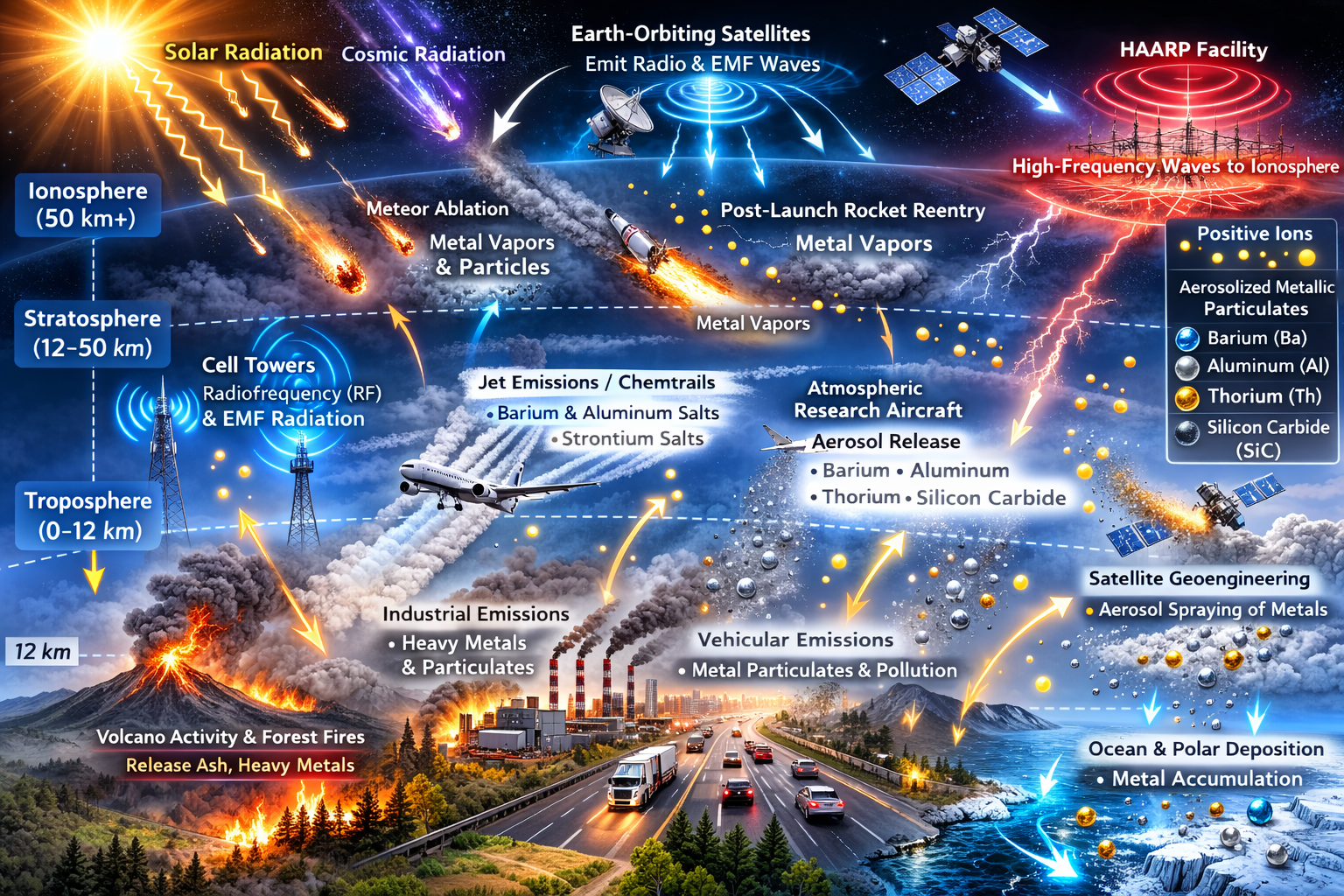
Why People Are Connecting The Dots
Public concern does not exist in a vacuum.
Geoengineering research exists. Weather modification techniques such as cloud seeding have been used and studied. Governments and militaries conduct atmospheric and communications research, some of which may not be immediately accessible to the public.
At the same time, people can observe persistent aircraft trails, rapidly expanding wireless infrastructure, unusual weather events, and technological changes occurring around them.
It is understandable that people connect these observations and ask whether they could be related. The important next step is separating observation, correlation, hypothesis, and demonstrated causation.
What We Can Say With Confidence
Several pieces of this discussion are well established. The atmosphere is electrically dynamic. Aerosols and particulates can influence atmospheric and cloud processes. Humans release significant quantities of particulate matter into the atmosphere. Weather modification technologies exist and have been used.
Where greater caution is needed is in connecting all of these facts into a single explanation for unusual weather or atmospheric behavior.
There is still much to understand about the interaction between natural atmospheric systems and the increasingly technological environment humans have created.
Asking thoughtful questions should be part of that process.
A Faith Perspective
Matthew 8:26-27 NKJV
26 But He said to them, “Why are you fearful, O you of little faith?” Then He arose and rebuked the winds and the sea, and there was a great calm. 27 So the men marveled, saying, [a]“Who can this be, that even the winds and the sea obey Him?”
Gina’s Thoughts:
We are thoughtful and aware, and we don’t have to accept every narrative without taking time to reflect.
At the same time, wisdom invites us to think clearly, consider information and carefully pursue truth with discernment.
True strength isn’t blind belief or automatic rejection, it’s the courage to ask questions and the maturity to examine what we find.
James 1:5: “If any of you lacks wisdom, you should ask God, who gives generously to all without finding fault, and it will be given to you”.
#AtmosphericScience #Ionosphere #Stratosphere #Troposphere #GeoengineeringDebate #AerosolResearch #EnvironmentalAwareness #SkyWatch #WeatherModification #SolarRadiation #CosmicRadiation #MetalParticulates #Aluminum #Barium #Thorium #SiliconCarbide #HAARPResearch #SatelliteTechnology #RFSignals #AirQuality #ClimateDiscussion #EarthSystems #EnvironmentalHealth